Solar Battery and Energy Storage Testing in India

ITC Lab Team
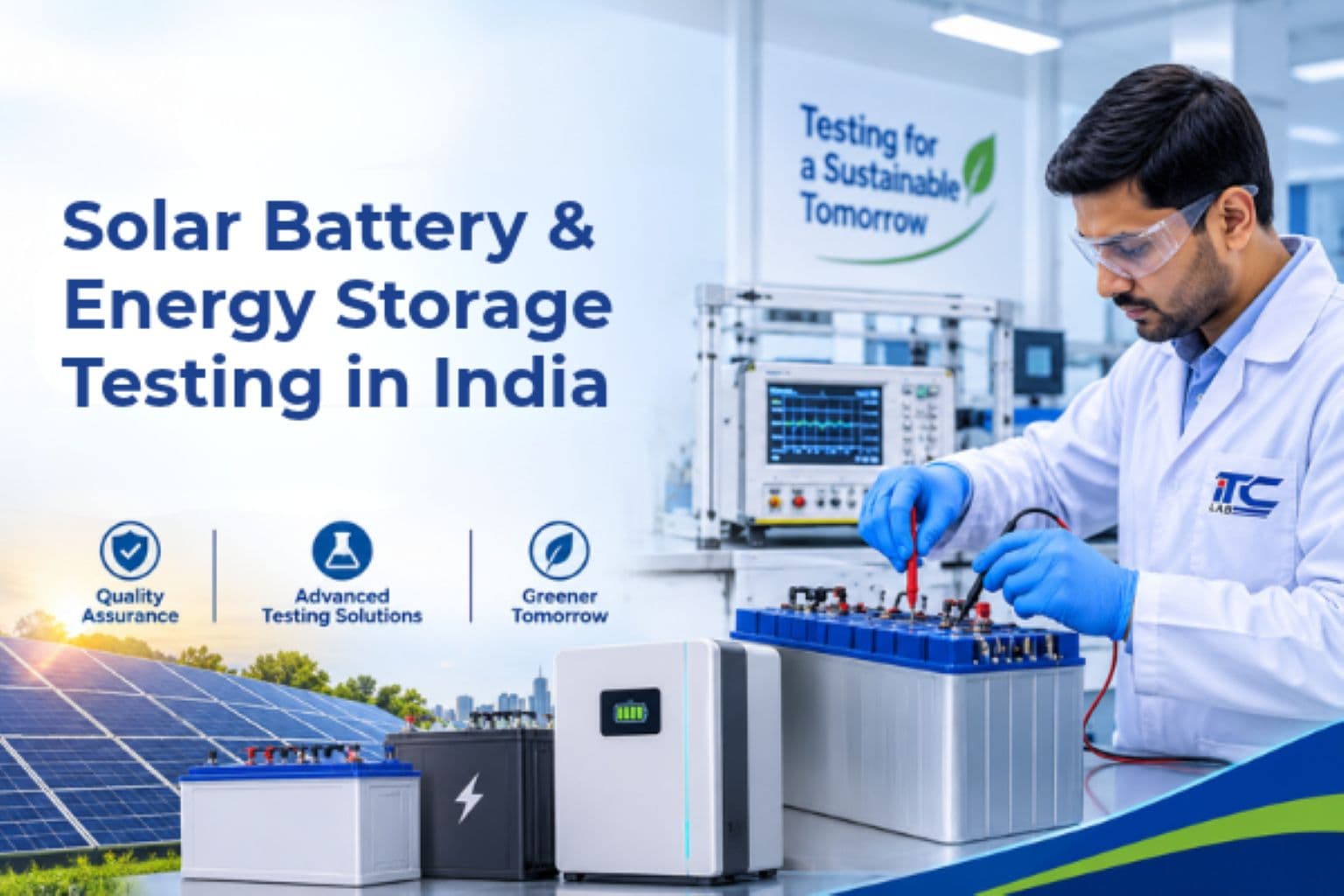
Solar Battery and Energy Storage Testing in India
The renewable energy industry is growing rapidly, and solar power has become an important source of electricity for residential, commercial, and industrial applications across India. As more businesses and households adopt solar energy, the demand for reliable energy storage solutions is also increasing. Solar batteries play an essential role in this process by storing electricity generated through solar panels and supplying it whenever required.
However, installing solar panels is not enough to ensure a reliable energy system. The quality, safety, and performance of solar batteries are equally important. A battery must be capable of storing energy efficiently, handling repeated charging and discharging cycles, and operating safely under different environmental conditions.
This is why solar battery and energy storage testing has become an important part of the renewable energy industry. Testing helps manufacturers evaluate product quality, identify potential issues, and understand whether their batteries meet the required technical specifications.
ITC Lab (International Testing and Compliance) supports businesses with product testing and compliance-related requirements. In this article, we explore the importance of solar battery testing, different testing procedures, relevant standards, and the role of testing laboratories in India's growing renewable energy sector.
What Is Solar Battery and Energy Storage Testing?
Solar battery testing is the process of evaluating the safety, performance, efficiency, and durability of batteries used in solar energy storage systems. Solar panels generate electricity during daylight hours, but energy consumption does not always happen at the same time. Batteries store the extra electricity generated during the day and make it available during nighttime or periods of low sunlight.
Different battery technologies, including lithium-ion and lead-acid batteries, are used in solar energy storage applications. Each technology has different performance characteristics and testing requirements.
Parameters Evaluated During Solar Battery Testing
🔋 Battery capacity and energy storage performance
⚡ Charging and discharging efficiency
🔄 Battery cycle life and durability
🛡️ Electrical safety and protection
🌡️ Temperature and thermal performance
📊 Internal resistance
⚠️ Overcharge and over-discharge behaviour
🧠 Battery management system performance
These evaluations help manufacturers understand how their products perform under specified operating conditions. Explore ITC Lab's Cells & Batteries Testing services.
Why Is Solar Battery Testing Important?
Solar batteries are expected to deliver consistent performance over an extended period. During regular operation, they experience charging cycles, electrical loads, temperature variations, and other environmental conditions. Without proper testing, manufacturers may find it difficult to identify technical weaknesses that could affect battery performance or safety.
Improved Battery Safety
Battery safety is one of the most important considerations in energy storage systems. Depending on battery chemistry and design, certain operating conditions may create risks such as overheating, leakage, short circuits, or thermal runaway. Safety testing evaluates how a battery responds under specified normal and abnormal conditions, helping identify potential hazards and assess the effectiveness of protective mechanisms.
Better Battery Performance
The performance of a solar battery directly affects the efficiency of an energy storage system. Testing helps measure important parameters such as voltage, current, storage capacity, and charging and discharging characteristics. These results help manufacturers verify whether their products perform according to their declared specifications.
Longer Battery Life
Solar batteries undergo repeated charging and discharging cycles. Over time, these cycles can gradually reduce their storage capacity. Cycle life testing helps evaluate how battery performance changes after repeated operations. This information is useful for understanding battery ageing and improving product durability.
Product Quality Assurance
Testing provides manufacturers with technical information about their products. It helps identify performance variations, design weaknesses, and possible safety concerns before products reach customers — protecting both brand reputation and end-user safety.
Major Types of Solar Battery Testing
Different testing procedures are used to evaluate battery performance, safety, and reliability. The exact tests depend on the battery technology, product category, and applicable standards.
A. Battery Capacity Testing
Measures the amount of electrical energy a battery can store and deliver under specified conditions. This test helps determine whether the actual battery capacity matches the manufacturer's declared rating — particularly important because storage capacity determines how much electricity can be supplied to connected equipment.
B. Charge and Discharge Testing
Evaluates how efficiently a battery accepts and delivers energy. It helps assess charging behaviour, discharge characteristics, voltage stability, and overall electrical performance — critical for solar applications where batteries regularly store and release electricity.
C. Cycle Life Testing
Evaluates how a battery's capacity changes after repeated charging and discharging cycles. This test is important for solar applications because batteries are regularly used to store electricity during periods of solar generation and supply it when required. Results provide useful information about battery durability and performance degradation.
D. Temperature and Thermal Testing
Temperature can significantly influence battery performance, efficiency, and safety. Thermal testing evaluates battery behaviour under specified temperature conditions, helps identify potential overheating issues, and determines how environmental temperature variations affect battery operation.
E. Overcharge and Over-Discharge Testing
Charging a battery beyond its recommended voltage or discharging it excessively can affect performance and safety. These tests evaluate the battery's response under specified abnormal charging and discharging conditions and help assess the protection features provided by the Battery Management System (BMS).
F. Short Circuit Testing
Evaluates the response of a battery under specified short-circuit conditions. It helps identify possible electrical and thermal hazards and assesses whether appropriate protective measures are included in the battery design.
G. Internal Resistance Testing
Measures the resistance within a battery during electrical operation. Higher internal resistance can contribute to energy losses, heat generation, and reduced battery performance. This test provides useful information about the electrical characteristics and condition of a battery.
Need battery testing for your solar product?
Request a QuoteUnderstanding Energy Storage System Testing
Energy storage system testing goes beyond evaluating individual battery cells. A complete solar energy storage system may include battery modules, inverters, battery management systems, monitoring equipment, cooling arrangements, and electrical protection components. All these components need to work together to ensure safe and reliable operation.
⚡ Electrical Performance Testing
Evaluates voltage, current, power output, energy capacity, and system efficiency.
🧠 Battery Management System Testing
Examines monitoring, battery balancing, control, and protection functions.
🌡️ Thermal Management Testing
Evaluates how the system manages heat during charging and discharging operations.
🌦️ Environmental Testing
Assesses system performance under specified temperature, humidity, and environmental conditions.
🛡️ Protection System Testing
Examines the response of protective mechanisms under defined abnormal electrical conditions.
Testing helps manufacturers understand how individual components perform and how they work together within a complete energy storage system. Learn about solar energy product testing.
Important Standards for Solar Battery Testing
Testing standards provide technical guidelines and procedures for evaluating battery safety, performance, and reliability. The applicable standards depend on battery chemistry, product design, intended application, and regulatory requirements.
| Standard | Scope / Application |
|---|---|
| IEC 62619 | Safety requirements and tests for secondary lithium cells and batteries used in industrial applications, including stationary applications. |
| IEC 63056 | Safety requirements for secondary lithium cells and batteries used in electrical energy storage systems. |
| IEC 62133-2 | Safety requirements for portable sealed secondary lithium cells and batteries. |
| IEC 61427-1 | Secondary batteries used in renewable energy storage applications, including off-grid photovoltaic systems. |
| UN 38.3 | Testing requirements for the safe transportation of lithium batteries. |
Important: Manufacturers should select the correct standard according to their battery type and intended application. They should also verify the latest applicable editions and relevant Indian regulatory requirements before arranging product testing.
Solar Battery Testing in India: Supporting Renewable Energy Growth
India is witnessing significant growth in renewable energy adoption. Solar power installations are increasing across residential buildings, commercial establishments, industrial facilities, and agricultural applications. As solar energy adoption grows, the demand for reliable energy storage solutions is also increasing.
This makes Solar Battery Testing in India an important part of the renewable energy supply chain. Manufacturers need to evaluate their battery products for safety, electrical performance, capacity, and durability. Proper testing helps identify possible technical issues and provides useful information for product development and quality improvement.
Testing is also relevant for importers, exporters, suppliers, and companies involved in manufacturing complete energy storage systems. A suitable testing laboratory can help businesses understand applicable test requirements and evaluate products according to relevant technical standards.
Solar Battery Testing in Delhi and Noida
Delhi and Noida are important commercial and industrial locations in the National Capital Region (NCR). Businesses operating in these areas are increasingly exploring renewable energy technologies, solar installations, and energy storage solutions.
Solar Battery Testing in Delhi
The growing use of solar energy has increased the importance of product quality and performance evaluation. Solar Battery Testing in Delhi is relevant for battery manufacturers, importers, suppliers, and renewable energy companies looking to evaluate the technical characteristics of their products.
Testing helps businesses understand battery capacity, charging and discharging performance, electrical safety, and other important parameters. Before selecting a testing laboratory, businesses should verify its available facilities, relevant test methods, and accreditation scope.
Solar Battery Testing in Noida
Noida is an important industrial and business hub with companies working in electronics, electrical equipment, manufacturing, and renewable energy solutions. Solar Battery Testing in Noida is an important consideration for businesses involved in developing, manufacturing, or supplying solar energy storage products.
Appropriate testing helps manufacturers evaluate product performance and identify possible technical limitations. It also supports quality assurance and helps businesses understand relevant compliance requirements.
For companies operating across Delhi, Noida, and other NCR locations, selecting a suitable testing partner can make the product evaluation process more organised. ITC Lab is based in Faridabad and serves businesses across the NCR region.
How to Find the Best Solar Battery Testing in NCR
Choosing a testing laboratory requires careful consideration. Businesses should not select a laboratory based only on price or location. Technical capabilities, relevant testing standards, and accreditation scope are equally important. If you are searching for the Best Solar Battery Testing in NCR, consider the following points before selecting a laboratory:
A suitable testing laboratory can help manufacturers identify product limitations, understand technical requirements, and improve product quality.
Who Needs Solar Battery Testing Services?
Solar battery testing is relevant to different businesses operating in the renewable energy and electrical equipment industries.
Solar Battery Manufacturers
Require testing to evaluate product safety, performance, durability, and quality.
Solar Energy Companies
Businesses providing solar installation solutions may need battery testing information to assess suitability of energy storage products.
Importers and Exporters
Companies involved in international battery trade may require relevant test reports and compliance documentation.
Energy Storage System Manufacturers
Businesses developing complete energy storage solutions need to evaluate performance and safety of individual components and integrated systems.
R&D Organisations
Testing helps researchers understand battery behaviour, compare technologies, and improve energy storage solutions.
Benefits of Professional Solar Battery Testing
Professional testing offers several advantages for manufacturers and businesses involved in the energy storage industry:
- ✓ Improved understanding of battery performance
- ✓ Better product quality and reliability
- ✓ Identification of potential safety concerns
- ✓ Evaluation of battery capacity and durability
- ✓ Support for product development and improvement
- ✓ Verification of declared technical specifications
- ✓ Assistance with applicable compliance requirements
- ✓ Greater confidence among customers and business partners
Regular quality evaluation helps manufacturers develop dependable products and maintain consistent quality standards.
Why Choose ITC Lab for Testing and Compliance Requirements?
Selecting the right testing laboratory is an important step for businesses involved in the solar energy and energy storage industry. ITC Lab (International Testing and Compliance) provides testing and compliance-related services for different product categories. Businesses can approach the laboratory to discuss their product requirements and understand the relevant testing procedures.
Technical Expertise
Relevant technical knowledge and testing capabilities for the required product category.
Testing Infrastructure
Appropriate equipment and facilities essential for conducting the required evaluations.
Applicable Standards
Testing follows relevant national or international standards according to the product's intended application.
Accurate Reporting
Clear and properly documented test reports that help manufacturers understand test results and product performance.
Accreditation & Recognition
Businesses can verify the laboratory's current accreditation status and approved scope for specific testing activities.
NCR Location
Based in Faridabad, serving businesses across Delhi, Noida, and the wider NCR region.
Important note: ITC Lab is a testing laboratory. We conduct product testing and issue test reports. BIS documentation, application filing, and certification assistance are typically handled by specialized consultancy firms.
Frequently Asked Questions (FAQs)
Q1: What is solar battery testing?
Solar battery testing is the process of evaluating the safety, capacity, electrical performance, durability, and reliability of batteries used in solar energy storage systems. It helps manufacturers understand whether their products meet the required technical specifications.
Q2: Why is solar battery testing important?
Solar battery testing helps identify potential safety risks, evaluate charging and discharging performance, check battery capacity, and understand product durability. It also supports quality assurance and applicable regulatory compliance.
Q3: Which standards are used for solar battery testing?
Some commonly relevant standards include IEC 62619, IEC 63056, IEC 62133-2, and IEC 61427-1. The applicable standard depends on battery chemistry, design, and intended application.
Q4: Where can I get Solar Battery Testing in India?
Manufacturers, importers, and suppliers can approach suitable product testing laboratories in India. Before selecting a laboratory, check its testing capabilities, relevant standards, and accreditation scope. Contact ITC Lab to discuss your requirements.
Q5: Is Solar Battery Testing available in Delhi and Noida?
Businesses looking for Solar Battery Testing in Delhi or Solar Battery Testing in Noida can contact suitable testing laboratories serving the NCR region. They should confirm the availability of specific tests before submitting their battery samples.
Q6: What parameters are checked during solar battery testing?
Important parameters include battery capacity, voltage, current, charging and discharging performance, cycle life, internal resistance, thermal behaviour, and electrical safety.
Q7: What is cycle life testing in solar batteries?
Cycle life testing evaluates how a battery's capacity changes after repeated charging and discharging cycles. It helps manufacturers understand battery ageing, durability, and long-term performance under specified conditions.
Q8: How can I find the Best Solar Battery Testing in NCR?
To find the Best Solar Battery Testing in NCR, compare laboratories based on their technical capabilities, testing infrastructure, applicable standards, experience, and current accreditation scope.
Q9: Does solar battery testing help improve product quality?
Yes. Testing helps identify technical weaknesses, performance variations, and potential safety concerns. Manufacturers can use the results to improve battery design, production processes, and product reliability.
Q10: How can ITC Lab help with solar battery testing requirements?
ITC Lab (International Testing and Compliance) can be approached for information about product testing and compliance requirements. Businesses should contact the laboratory to confirm the availability of specific solar battery testing services and applicable standards.
Partner with ITC Lab for Solar Battery Testing
Solar batteries and energy storage systems are becoming essential components of modern renewable energy solutions. Solar battery testing helps manufacturers assess battery capacity, charging and discharging performance, cycle life, thermal behaviour, and electrical safety — providing valuable technical information for improving product quality and meeting compliance requirements.
Explore our services: Cells & Batteries Testing | Solar Energy Products Testing | Environmental Testing