Why Product Testing is Essential for Electrical and Electronic Products: A Complete Guide for Manufacturers
ITC Lab Team
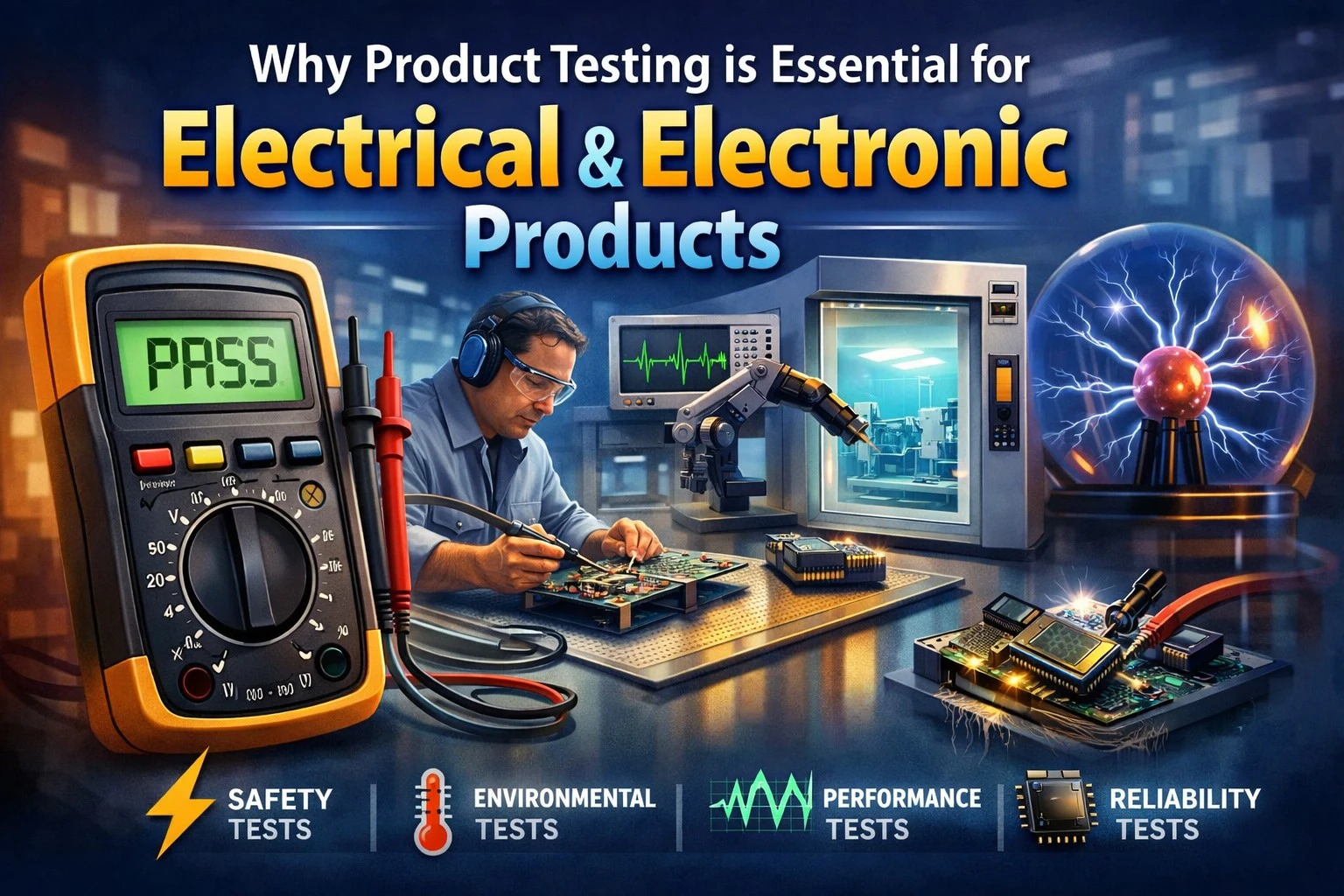
Why Product Testing is Non‑Negotiable for Electrical & Electronic Products
Electrical and electronic products power our modern world — from smartphones and laptops to refrigerators and industrial control systems. But with this power comes significant risk. Faulty wiring, inadequate insulation, electromagnetic interference, or poor thermal management can lead to electric shocks, fires, data loss, or even loss of life. Product testing is the only way to ensure that these products are safe, reliable, and compliant with mandatory Indian standards.
In India, the Bureau of Indian Standards (BIS) mandates certification for over 60 electrical and electronic products under the Compulsory Registration Scheme (CRS) or the ISI Mark scheme. Without proper testing, manufacturers cannot legally sell, import, or store these products in the country. Moreover, e‑commerce platforms like Amazon and Flipkart increasingly require proof of compliance before listing.
This comprehensive guide explains why product testing is essential for electrical and electronic products, what types of tests are required, and how International Testing and Compliance (OPC) Lab — a BIS-recognized, NABL-accredited and IQAS-approved laboratory — can help you achieve compliance and market readiness efficiently.
Why Product Testing is Essential: 5 Key Reasons
1. Safety Assurance
Electrical products carry inherent risks: electric shock, fire, overheating, and arc flash. Testing verifies critical safety parameters such as insulation resistance, dielectric strength, leakage current, and earthing continuity. Without these checks, a seemingly minor design flaw can lead to catastrophic failures.
Real‑world impact: In 2020, a batch of power adapters without proper insulation caused multiple house fires in Delhi. BIS cancelled registrations, and the manufacturer faced legal action and brand ruin.
2. Regulatory Compliance
BIS certification under CRS or ISI is mandatory for most electrical and electronic products sold in India. Testing at a BIS‑recognized lab like ITC Lab is the first and most critical step. Without valid test reports, your application will be rejected, and your products cannot legally enter the market.
Key regulatory schemes:
- Compulsory Registration Scheme (CRS) – for electronics and IT goods
- ISI Mark Scheme – for electrical appliances and industrial equipment
- BEE Star Rating – for energy efficiency labeling
3. Reliability & Performance Validation
Customers expect products to work as advertised — for years. Testing validates functional parameters, endurance under continuous operation, and performance under extreme conditions. A product that fails early leads to returns, warranty claims, and negative reviews.
Key performance tests include: energy efficiency (BEE), load testing, standby power measurement, and accelerated life testing.
4. EMC/EMI Compliance
Electromagnetic interference (EMI) from your product can disrupt nearby devices — from pacemakers to aircraft navigation systems. Conversely, poor immunity means your product may malfunction when exposed to common disturbances like static electricity or radio frequency fields.
Testing ensures your product meets CISPR and IEC 61000 standards, which are mandatory for most electronics under BIS CRS. Learn more about EMC testing.
5. Brand Protection & Cost Savings
A single product recall can cost crores in logistics, legal fees, and lost consumer trust. Testing uncovers design flaws and component weaknesses before mass production, saving you from expensive field failures.
Investing a few thousand rupees in testing can prevent a recall that could run into crores — a clear ROI case.
6. Environmental Durability
Electrical products must withstand temperature extremes, humidity, vibration, dust, and water ingress. Environmental testing — including temperature cycling, salt spray, IP rating verification, and vibration tests — ensures your product works reliably in real‑world conditions, whether in a Chennai summer or a Himalayan winter.
ITC Lab Expertise: Environmental and ingress protection testing for all product categories.
Essential Tests for Electrical & Electronic Products
⚡ Safety Testing
- Dielectric strength (high voltage withstand)
- Insulation resistance
- Leakage current measurement
- Grounding continuity
- Creepage and clearance distances
- Flammability / glow wire test
Standards: IS 302, IS 13252, IEC 60335, IEC 60950
📡 EMC/EMI Testing
- Radiated emissions
- Conducted emissions
- ESD immunity
- Electrical fast transient (EFT) immunity
- Surge immunity
- Radiated RF immunity
Standards: CISPR 11/14/32, IEC 61000-4 series
🌡️ Environmental Testing
- Temperature cycling / thermal shock
- Humidity (damp heat) testing
- Salt spray / corrosion test
- Vibration and mechanical shock
- IP rating (dust/water ingress)
- Altitude / low pressure simulation
Standards: IEC 60068, IS 9000, MIL-STD-810
📊 Performance & Energy Efficiency
- Power consumption (active/standby/off)
- Efficiency measurement (power supplies, motors)
- Load and functional testing
- Endurance / life testing
- BEE star rating verification
Standards: BEE schedules, IEC 62301, IS specific
Consequences of Skipping Product Testing
- •
Regulatory Rejection & Legal Penalties: BIS will reject your application without valid test reports. Selling non‑compliant products can lead to fines up to ₹2 lakh or imprisonment under the BIS Act, 2016. Customs may seize imported goods.
- •
Product Recalls & Financial Loss: In 2019, a major Indian electronics brand recalled 10,000 LED TVs due to fire risk — costing over ₹5 crore. Testing would have revealed the faulty component early.
- •
Brand Damage & Lost Trust: Negative reviews on e‑commerce platforms spread fast. A product with 1‑star ratings due to early failures will struggle to recover.
- •
Warranty & Service Costs: High failure rates increase service center load and warranty replacement costs, eating into profits.
Step‑by‑Step Testing Process at ITC Lab
Industry‑Specific Testing Requirements
🏠 Home Appliances
Focus on safety (IS 302), energy efficiency (BEE star rating), and performance. Common issues: motor overheating, inadequate insulation, high power consumption. Learn more
💻 IT Equipment
Safety (IS 13252) and EMC (CISPR 32) are critical. Power supplies must meet efficiency standards. Data security features may also be tested. Learn more
🔋 Batteries & Power Banks
Electrical tests (overcharge, short circuit), mechanical abuse (crush, drop), thermal stability, and altitude simulation. IS 16046 (IEC 62133). Learn more
💡 LED Lighting
Safety (IS 10322), photometry (luminous flux, color temperature), EMC, and endurance testing. Learn more
📡 Telecom Products
TEC certification requires safety, EMC, and radio frequency (RF) testing. Protocol conformance for 2G/3G/4G/5G, Bluetooth, Wi‑Fi. Learn more
🏭 Industrial Equipment
ISI Mark requirements: safety (IS 302), environmental robustness, mechanical endurance, and factory inspection. Learn more
Key Indian & International Standards for Electrical/Electronic Products
| Product Category | Indian Standard (IS) | International Equivalent |
|---|---|---|
| Household Appliances | IS 302 | IEC 60335 |
| IT Equipment | IS 13252 (Part 1) | IEC 60950 / IEC 62368 |
| Audio/Video Equipment | IS 616 | IEC 60065 |
| LED Lighting | IS 10322 (Part 5) | IEC 60598, IEC 62031 |
| Batteries | IS 16046 | IEC 62133 |
| EMC/EMI | IS 12640, IS 13779 | CISPR 11/14/32, IEC 61000-4 |
| Environmental | IS 9000 series | IEC 60068, MIL-STD-810 |
Why Choose ITC Lab for Electrical & Electronic Product Testing?
BIS‑recognized, NABL‑accredited & IQAS‑approved
Our test reports are accepted by BIS for CRS and ISI applications. Accreditations ensure global acceptance.
Comprehensive Facilities
EMC chambers, environmental chambers, safety test setups, photometry lab — all under one roof.
Expert Consultation
Our team includes former BIS officials and industry veterans who understand the nuances of electrical/electronic compliance.
Fast Turnaround
Typical test completion in 7‑10 working days, with expedited options for urgent projects.
Frequently Asked Questions (FAQs)
Q1: Is product testing mandatory for all electrical products sold in India?
Yes for products covered under BIS CRS or ISI scheme. The list includes over 60 categories such as mobile phones, adapters, LED TVs, refrigerators, ACs, wires, switches, etc. Check the BIS website or our CRS page for the latest list.
Q2: What happens if I sell electrical products without BIS certification?
Penalties under the BIS Act, 2016 include imprisonment up to 2 years, fines up to ₹2 lakh, and seizure/destruction of goods. Customs may also block imports.
Q3: How long does testing take for electrical products?
Typical testing time is 7‑10 working days. Complex products with multiple test types may take 2‑3 weeks. ITC Lab provides a detailed timeline during consultation.
Q4: What are the most common test failures for electrical products?
Common failures include insufficient creepage/clearance distances, high leakage current, poor EMC performance (especially radiated emissions), and inadequate thermal management leading to overheating.
Q5: Can ITC Lab test for international markets (CE, UL, etc.)?
Yes, we test to IEC, CISPR, ISO, and other international standards. While we are BIS‑recognized for Indian certification, our NABL accreditation ensures our test reports are globally accepted for CE, FCC, and other schemes.
Q6: How many samples do I need to submit?
Typically 3‑5 samples. Destructive tests (e.g., flammability, salt spray) may require dedicated samples. We'll advise based on your test matrix.
Q7: What is the cost range for electrical product testing?
Costs vary by product and test types: safety (₹15,000‑40,000), EMC (₹25,000‑60,000), environmental (₹20,000‑50,000). Contact ITC Lab for a customized quote.
Q8: Do I need to test if I'm only exporting from India?
If you are selling in India, you must comply with BIS. For exports only, your target country's standards apply (CE for Europe, UL for USA). We can test to both.
Q9: What is the difference between CRS and ISI for electrical products?
CRS (Compulsory Registration Scheme) applies to electronics and IT goods, requires no factory inspection, and registration is valid for 2 years. ISI applies to electrical appliances and industrial equipment, requires factory inspection, and license is valid for 1 year with annual renewal.
Q10: How do I start the testing process with ITC Lab?
Simply contact us with your product details. We'll identify applicable standards, provide a quote, and guide you through sample submission and testing.
Ensure Safety, Compliance & Reliability with ITC Lab
Product testing is not an expense — it's an investment in your brand, your customers' safety, and your market success. Partner with ITC Lab, your BIS‑recognized, NABL‑accredited and IQAS‑approved testing partner.
Explore our services: Electronic Appliances | Electrical Appliances | EMC Testing | CRS Testing