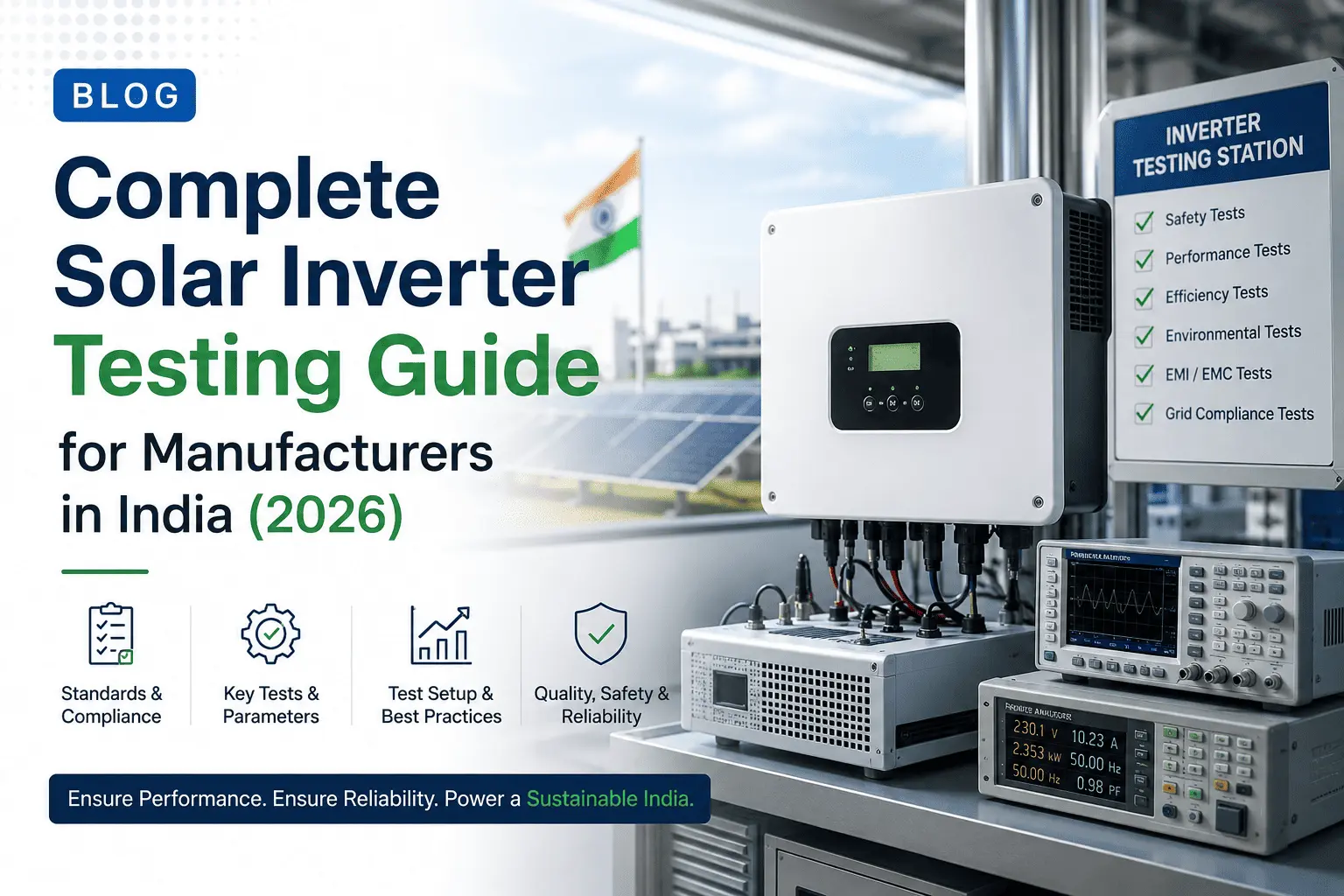
Complete Solar Inverter Testing Guide for Manufacturers in India (2026)
ITC Lab Team
Why Solar Inverter Testing is Critical in India’s Renewable Energy Boom
India has set an ambitious target of 500 GW of renewable energy capacity by 2030, with solar power contributing the lion’s share. Solar inverters — the heart of any photovoltaic (PV) system — convert DC power from solar panels into usable AC power for homes, businesses, and the grid. A single failure can lead to grid instability, fire hazards, electrocution, or massive energy losses.
To protect consumers and ensure grid safety, the Government of India has mandated that solar inverters must comply with specific Indian Standards (IS) and international IEC standards. The Ministry of New and Renewable Energy (MNRE) has issued guidelines making BIS certification compulsory for solar inverters sold in India. Additionally, grid‑tied inverters must meet connectivity and power quality requirements set by state electricity boards.
This comprehensive guide explains everything solar inverter manufacturers need to know about testing — from applicable standards and BIS certification procedures to the essential test types, common pitfalls, and how International Testing and Compliance (OPC) Lab — a BIS-recognized, NABL-accredited and IQAS-approved laboratory — can help you achieve compliance quickly and cost‑effectively.
Applicable Standards & Regulations for Solar Inverters in India
BIS Certification Requirements
Solar inverters fall under the Compulsory Registration Scheme (CRS) notified by the Ministry of Electronics & IT (MeitY). The applicable Indian Standards are:
- IS 16221 (Part 1): Safety of power converters for use in photovoltaic power systems — General requirements (based on IEC 62109‑1)
- IS 16221 (Part 2): Safety of power converters for use in photovoltaic power systems — Particular requirements for inverters (based on IEC 62109‑2)
- IS 16169: Utility‑interconnected photovoltaic inverters — Test procedure for islanding prevention measures
Additionally, grid‑tied inverters may need to comply with state‑specific grid codes (e.g., CEA Technical Standards).
MNRE Guidelines & Subsidy Requirements
For solar inverters to be eligible for government subsidies (e.g., PM‑Surya Ghar Muft Bijli Yojana), MNRE mandates:
- BIS registration under CRS
- Performance testing as per IEC 61683 (efficiency measurement)
- Environmental testing (IEC 60068) for outdoor use
- EMC compliance (CISPR 11, IEC 61000‑6‑2/‑4)
ITC Lab is fully equipped to conduct all MNRE‑required tests. Learn more about solar energy product testing.
Essential Tests for Solar Inverters (Detailed)
1. Safety Testing (IS 16221 / IEC 62109)
Ensures protection against electric shock, fire, and mechanical hazards. Key tests include:
- Dielectric strength: High voltage withstand between input/output and enclosure
- Insulation resistance: Measures isolation between PV side and AC side
- Leakage current: Ground and touch current measurement
- Creepage & clearance distances: On PCB and terminals
- Thermal cycling & overload: Under rated and abnormal conditions
- Enclosure mechanical strength: Impact and ingress protection (IP rating)
Critical for BIS CRS – mandatory.
2. EMC/EMI Testing (CISPR 11, IEC 61000)
Solar inverters are powerful switching devices that can generate significant electromagnetic interference, affecting nearby electronics and grid communication systems.
- Radiated & conducted emissions: Class A (industrial) or Class B (residential) limits
- Harmonics & flicker: As per IEC 61000‑3‑2 / ‑3
- Immunity tests: ESD, EFT, surge, radiated RF, power frequency magnetic field
- Grid‑related disturbances: Voltage dips, short interruptions, and voltage variations
ITC Lab’s EMC Test Facility is fully equipped for all these tests.
3. Performance & Efficiency Testing (IEC 61683)
Measures how effectively the inverter converts DC to AC power. MNRE requires minimum efficiency levels for subsidy eligibility.
- Conversion efficiency: At 10%, 20%, 30%… 100% of rated load
- European efficiency (weighted average): For grid‑tied inverters
- Maximum Power Point Tracking (MPPT) accuracy: Dynamic and static tracking tests
- Total harmonic distortion (THD) of output voltage/current
- Power factor and reactive power capability
Performance testing for BEE/MNRE available at ITC Lab.
4. Environmental & Ingress Protection Testing (IEC 60068, IEC 60529)
Solar inverters are often installed outdoors or in harsh environments (rooftops, deserts, coastal areas). They must withstand:
- Temperature extremes: Dry heat and cold (−20°C to +60°C operation)
- Damp heat (humidity): 95% RH non‑condensing
- Salt spray: For coastal installations (corrosion resistance)
- Vibration & mechanical shock: During transport and operation
- IP rating: Typically IP65 for outdoor use (dust‑tight and water jets)
ITC Lab Expertise: Environmental and ingress protection testing for all solar products.
5. Grid Interconnection & Anti‑Islanding Tests (IS 16169, IEEE 1547)
Grid‑tied solar inverters must automatically disconnect when the grid fails (islanding prevention) and reconnect safely. Tests include:
- Anti‑islanding effectiveness: Active and passive methods (frequency, voltage, impedance)
- Grid voltage & frequency trip limits: Over/under voltage and frequency protection
- Synchronization: Reconnection after grid restoration
- DC injection into AC grid: Must be below 0.5% of rated current
- Power quality: Harmonics, flicker, and rapid voltage changes
These tests are mandatory for all grid‑connected solar inverters.
6. Reliability & Lifespan Testing
Solar inverters are expected to last 10‑15 years. Reliability tests help predict field performance:
- Accelerated life testing (HALT/HASS): Thermal and vibration stress to find weak points
- Temperature cycle endurance: Thousands of cycles between −20°C and +60°C
- Humidity freeze cycles: Condensation and freezing stresses
- Mean time between failures (MTBF) calculation
ITC Lab offers comprehensive reliability testing for solar inverters.
Solar Inverter Testing Standards – Quick Reference
| Test Category | Indian Standard | International Standard |
|---|---|---|
| Safety | IS 16221 (Part 1 & 2) | IEC 62109‑1 / ‑2 |
| Anti‑Islanding | IS 16169 | IEC 62116, IEEE 1547 |
| EMC/EMI | IS 12640, IS 13779 | CISPR 11, IEC 61000‑6 |
| Efficiency | – | IEC 61683 |
| Environmental | IS 9000 series | IEC 60068, IEC 60529 (IP) |
| Grid Protection | CEA Regulations | IEC 61727, VDE‑AR‑N 4105 |
Step‑by‑Step Solar Inverter Testing Process at ITC Lab
Common Pitfalls in Solar Inverter Testing & Solutions
- •
Incorrect standard selection: Some manufacturers wrongly apply IEC 60950 (IT equipment) instead of IEC 62109. Solution: Consult with experts before designing.
- •
EMC failures: High switching frequencies cause radiated emissions failures. Solution: Proper filtering, shielding, and PCB layout optimization. Pre‑testing at ITC Lab can catch issues early.
- •
Thermal management issues: Inverters running too hot reduce efficiency and lifespan. Solution: Proper heatsink design, airflow, and temperature rise testing.
- •
Islanding test failures: Anti‑islanding algorithms may not detect grid loss quickly enough. Solution: Validate with real grid simulator and adjust trip thresholds.
Why Choose ITC Lab for Solar Inverter Testing?
BIS‑Recognized & NABL‑Accredited
Our test reports are accepted for BIS CRS and MNRE approvals.
Complete Solar Testing Suite
Safety, EMC, performance, environmental, grid‑tie, and reliability – all under one roof.
Grid Simulator & Load Bank
We have programmable AC sources and regenerative loads to simulate real grid conditions.
Fast Turnaround
Typical testing completed in 10‑15 working days, with expedited options.
Frequently Asked Questions (FAQs)
Q1: Is BIS certification mandatory for all solar inverters in India?
Yes, for solar inverters sold in India, BIS CRS registration is mandatory as per MeitY notification. This applies to both domestic and imported inverters.
Q2: What is the difference between IS 16221 and IEC 62109?
IS 16221 is the Indian adoption of IEC 62109 with minor national deviations. Testing to either standard is generally accepted, but BIS specifically requires IS 16221.
Q3: How many samples do I need to submit for solar inverter testing?
Typically 2‑3 units. One for safety/EMC, one for performance/environmental, and optionally one for reliability/destructive tests. We advise based on your specific test plan.
Q4: What is the typical cost of solar inverter testing?
Costs vary by power rating and test scope. For a typical 5‑10 kW grid‑tied inverter, testing costs range from ₹1.5 lakh to ₹3 lakh. Contact ITC Lab for a customized quote.
Q5: How long does solar inverter testing take?
Typical timeline: 10‑15 working days for safety, EMC, performance, and basic environmental tests. Additional tests like grid interconnection or reliability may add 1‑2 weeks.
Q6: What is the minimum efficiency required for MNRE subsidy?
For grid‑tied inverters, MNRE typically requires a weighted efficiency (European efficiency) of at least 95% for inverters up to 10 kW, and 96% for larger inverters. Confirm latest guidelines.
Q7: Does ITC Lab test off‑grid hybrid inverters?
Yes, we test both grid‑tied and off‑grid/hybrid solar inverters. For off‑grid, the applicable standards include safety (IS 16221) and performance (battery charging, load handling).
Q8: What is anti‑islanding and why is it important?
Anti‑islanding is a safety feature that automatically disconnects the inverter from the grid when grid power fails. This protects utility workers from energised lines. It is mandatory for all grid‑tied inverters.
Q9: Can ITC Lab help with international certifications like CE or UL?
Yes, our NABL‑accredited reports are accepted globally. We test to IEC standards which form the basis for CE marking. For UL (US market), we can coordinate with CB‑scheme partners.
Q10: How do I start the solar inverter testing process with ITC Lab?
Simply contact us with your inverter specifications. We’ll send a test plan, quote, and timeline. We also offer a free initial consultation to clarify any regulatory doubts.
Accelerate Your Solar Inverter Certification with ITC Lab
Solar inverter testing is complex, but with the right partner, it doesn't have to be. ITC Lab offers end‑to‑end testing services tailored to BIS CRS, MNRE, and international standards. Let’s power India’s solar future together.
Explore our services: Solar Energy Products Testing | EMC Testing | Environmental Testing